Featured partnerFREE TO PLAY
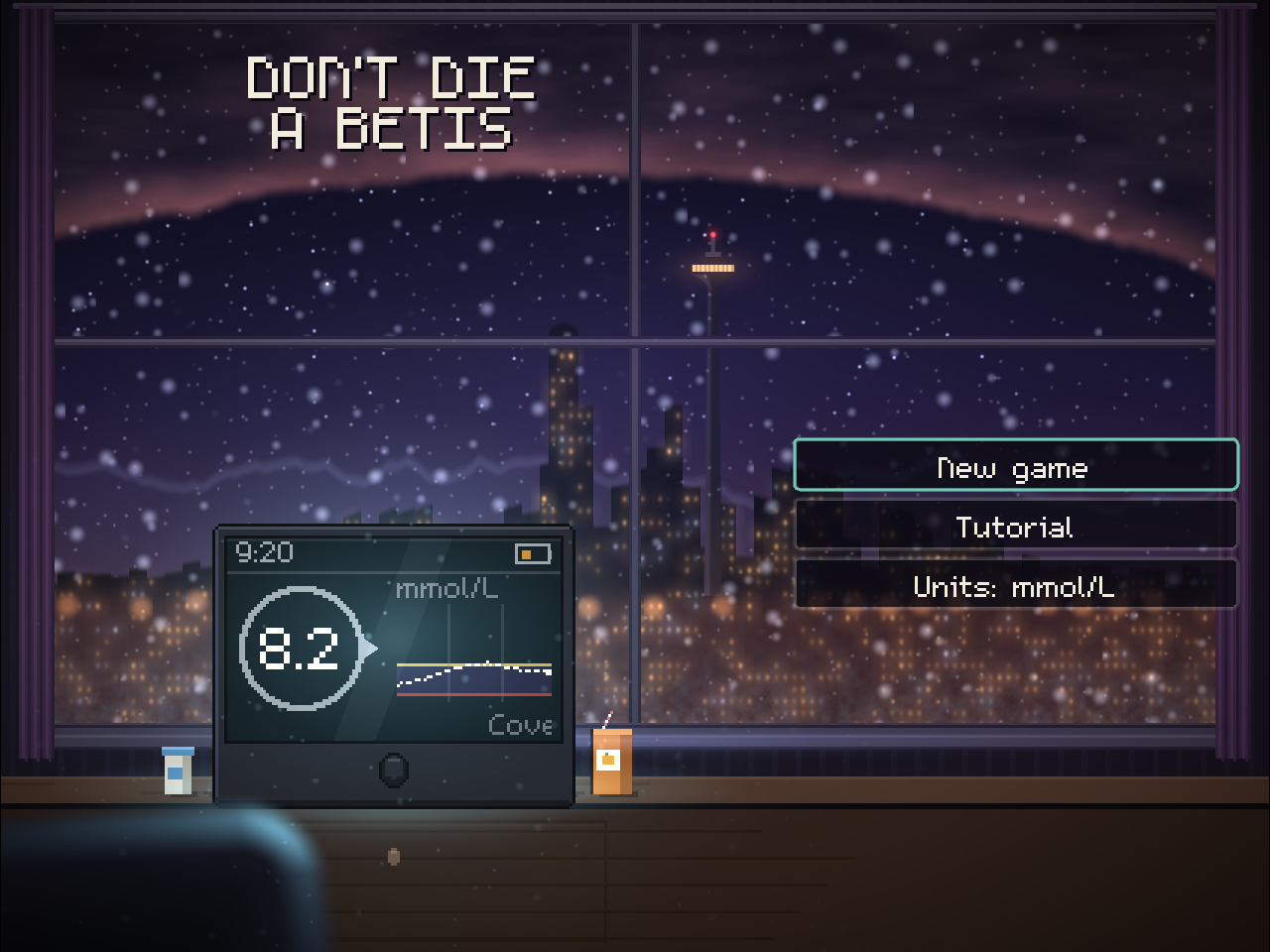
Don't Die a Betis
A beat 'em up about type 1, set in Calgary. Count carbs, dodge the Cinnamon Guy, and find a washroom before it is too late.
Play in your browserRead the instruction booklet.
What insulin does
Insulin is a hormone made by the pancreas. It helps sugar from the food you eat move out of your blood and into your body's cells, where it is used for energy. In type 1 diabetes, the pancreas stops making insulin, so you take it instead.
Diabetes Canada's guidelines call insulin the life-sustaining therapy for type 1. Your team decides with you how many injections you need, when to take them, how much to take, and whether a pump suits you. There is no single plan that fits everyone.
Basal and bolus
Most people with type 1 take insulin in two parts. Diabetes Canada recommends this approach, called basal-bolus, for adults with type 1.
- Basal insulin is background insulin. It keeps your blood sugar steady overnight and between meals, even when you are not eating. It is a long-acting or intermediate-acting insulin, usually taken once or twice a day.
- Bolus insulin is mealtime insulin. It covers the rise in blood sugar from a meal, and it is also used to bring down a high. It is a rapid-acting or short-acting insulin.
An insulin pump does both jobs: it gives a small, steady flow of insulin all day for basal, and a larger amount when you press a button for a meal. Your bolus dose depends partly on how much carbohydrate you eat. See Carb counting.
Types of insulin
Insulins are grouped by how quickly they start working and how long they last. These times are rough guides, and each product is a little different. Your pharmacist or the leaflet in the box will tell you about yours.
| Type | Used as | Roughly how it works |
|---|---|---|
| Rapid-acting | Bolus | Starts in about 15 minutes and lasts 2 to 4 hours. Taken just before meals. |
| Short-acting (regular) | Bolus | Starts in about 30 minutes and lasts about 3 to 6 hours. Taken before meals. |
| Intermediate-acting (cloudy) | Basal | Starts in 2 to 4 hours and lasts about 12 to 18 hours. |
| Long-acting | Basal | Starts several hours after the injection and works for about a day. |
| Ultra long-acting | Basal | Works for 36 hours or more, with no strong peak. |
Premixed insulins, which combine a fast and a slower insulin in one pen, also exist. Diabetes Canada's guidelines say they are not suitable for most adults with type 1, because type 1 needs frequent adjustments. Cloudy insulin needs gentle mixing before each use: roll it between your hands and tip it up and down, as your educator shows you.
Never stop your basal insulin
If you have type 1, your body needs some insulin all the time, even when you are not eating. Keep taking your basal insulin when you are sick, not eating or throwing up, unless your team tells you otherwise. Without insulin, ketones can build up quickly and cause diabetic ketoacidosis (DKA), an emergency.
If you can't eat or can't keep food down, call your team about your mealtime insulin and any changes to your doses. See Sick days and Highs and ketones.
Carry a card in your wallet that says you have type 1 diabetes, or wear a medical ID bracelet or necklace. In an emergency it tells others that you need insulin.
Pens, syringes and pumps
- Pens come filled with insulin and are easy to carry. You put a new needle tip on for each injection, and you need a separate pen for each type of insulin. Never share a pen, even with a new needle.
- Syringes draw insulin from a small bottle (a vial). Today's syringes are small with thin needles, and they cost less than pens.
- Pumps are small devices worn on the body that give insulin all day and night through a thin tube under the skin. Many work with a continuous glucose monitor. See Insulin pumps.
Use each needle or pen tip once, then put it in a sharps container. Many pharmacies give out puncture-proof containers and take full ones back.
Where to inject, and rotating sites
Insulin is injected just under the skin. The common places are:
- Belly: easy to reach, and insulin is absorbed quickly and evenly there. Stay about 5 cm (three finger widths) away from your belly button.
- Buttocks and thighs: insulin is absorbed more slowly.
- Outer arm: after the belly, the next fastest. It is hard to reach on your own, so it is often not recommended.
Change where you inject each time. Using the same spot again and again can cause fatty lumps under the skin, and insulin works poorly when it goes into them. Switch sides of your belly, and move to a slightly different spot each time.
Wash your hands and make sure the skin is clean before you inject. Don't inject through clothing. Your nurse or educator will show you how to give an injection step by step, including priming a pen so the needle is not blocked.
Storing insulin
Heat, sunlight and freezing damage insulin, and damaged insulin may not work.
- Unopened insulin goes in the fridge. Don't let it freeze.
- The pen or vial you are using can stay at room temperature. Diabetes Canada says it can be kept at room temperature for up to 30 days. Write the date you opened it on the label.
- Throw insulin out if it has been frozen, if it has been above 30°C, or if it is past its expiry date.
- Never leave insulin in the sun or in a hot car. Keep a spare of each type of insulin in the fridge at home.
Storage rules differ a little between products. Check the leaflet in the box or ask your pharmacist about yours.
In a Canadian winter, think about where your insulin sits when you are outdoors or it is left in a parked car. Insulin that has frozen has to be thrown out.
Follow your own diabetes care team. This page explains the general advice. Your doctor, nurse educator and dietitian know your body and your insulin, and their plan comes first.
Sources
- Diabetes Canada. Getting started with insulin.
- Diabetes Canada Clinical Practice Guidelines. Chapter 12: Glycemic management in adults with type 1 diabetes.
- Diabetes Canada Clinical Practice Guidelines. Chapter 41: Glycemic management across the lifespan for people with type 1 diabetes (2025).
- Breakthrough T1D Canada. Types of insulin.
- Breakthrough T1D Canada. Diabetic ketoacidosis (DKA) and ketones.
- HealthLink BC. Storing insulin and prefilling syringes.
- HealthLink BC. Sick-day guidelines for people with diabetes.
Checked against these sources in November 2026.