If your pump stops, act within hours
A pump holds no long-acting insulin, so if it stops, your sugar can climb fast and diabetic ketoacidosis (DKA) can start within a few hours. Give insulin by pen or syringe as your backup plan says, and check for ketones. With signs of DKA, such as vomiting, belly pain, trouble breathing or confusion, go to emergency or call 911.
Featured partnerFREE TO PLAY
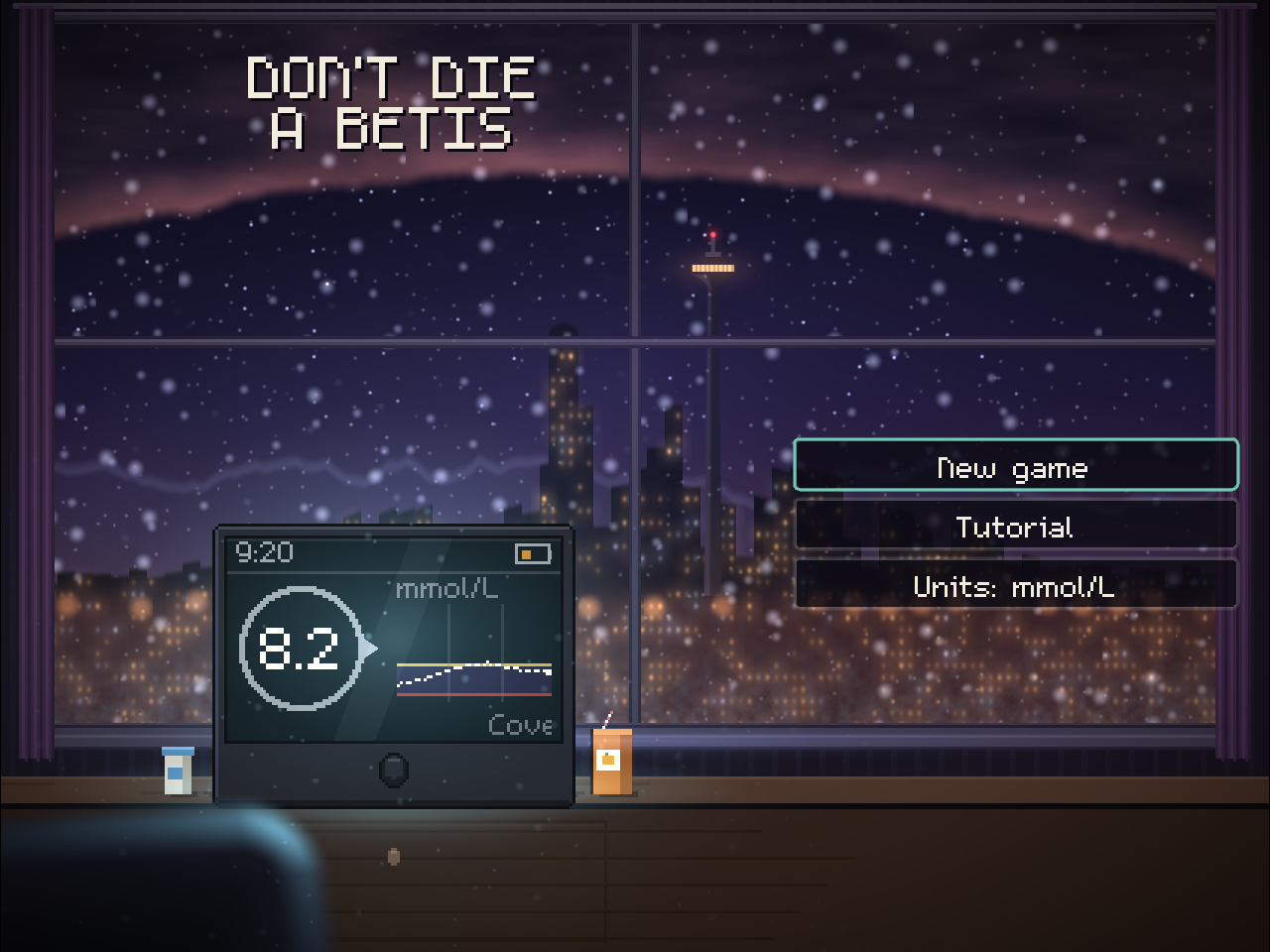
Don't Die a Betis
A beat 'em up about type 1, set in Calgary. Count carbs, dodge the Cinnamon Guy, and find a washroom before it is too late.
Play in your browserRead the instruction booklet.
What a pump does
A pump uses only rapid-acting insulin, and gives it in two ways.
- Basal insulin: a small, steady trickle, all day and night, to keep your sugar stable between meals and while you sleep. It does the job a long-acting shot does on injections. Your team sets the rates, and you can have different rates for different times of day.
- Bolus insulin: an extra dose you ask for, to cover the carbohydrate in a meal or to bring down a high. Pumps sold in Canada can work out the dose from the numbers you enter.
A pump does not do the work by itself. You still check your sugar, count carbohydrate, decide on and give meal and correction doses, refill the insulin, and change the spot where it goes in every 2 to 3 days. You also need to know what each alarm means and what to do about it.
Tubed and patch pumps
Tubed pumps are about the size of a deck of cards. You wear the pump on a belt, in a pocket or strapped on, and it holds the insulin. A thin tube runs from the pump to a cannula, a soft tube that sits under your skin. The tubing and cannula together are called an infusion set. The cannula usually goes in the belly, but the bum, leg or arm can work too.
Patch pumps, also called tubeless pumps or pods, stick straight onto your skin, with the cannula underneath. You control the pod wirelessly from a separate handheld device about the size of a phone.
All the pumps sold in Canada can work out meal and correction doses, hold more than one basal pattern, set temporary rates for exercise, show how much insulin is still working, and sound safety alarms. Your team can help you compare the rest.
Automated insulin delivery
Automated insulin delivery, or AID, links a pump to a real-time continuous glucose monitor (see Continuous glucose monitors). Software in the system reads your sugar and adjusts your basal insulin by itself: giving more, giving less or stopping it. Some systems also give small correction doses on their own. You may also hear it called a hybrid closed loop.
Diabetes Canada's 2025 guidelines say AID is the preferred way to give insulin for everyone with type 1, as long as you are willing and able to wear and run the devices. In studies, people using AID spent more time in range, with the biggest gains overnight. People also reported less diabetes distress and less fear of lows.
AID still needs you. Your team will show you what the system handles and what you still do yourself, such as meals and changing your sites.
Pros and cons
Alberta Health Services' pump course lists these.
| What people like | What is harder |
|---|---|
| Fewer injections | You are connected to it almost all the time |
| Insulin in the amounts and at the times you need it | Your sugar can rise fast if the pump or site has a problem, and the risk of DKA is higher |
| Less risk of lows and highs | You always need to carry a safety kit |
| More options for meal doses | Skin irritation or infection at the site; some clothes don't work with it |
| A more flexible day | It takes time and work to start, keep running and adjust, and readings can be unsteady for months at first |
Your A1C may be the same on a pump as on injections, or a bit better. If a pump doesn't suit you, Diabetes Canada recommends a CGM alongside your injections.
If your pump stops
A pump uses no intermediate-, long- or ultra-long-acting insulin. If insulin stops getting in and you don't notice, your sugar can go dangerously high, or DKA can start, in just 2 to 4 hours. That can happen even if your sugar was normal or low when it stopped.
Insulin can stop getting in when:
- the site has been left in too long and is irritated or infected
- the cannula or tubing is loose, kinked or leaking
- the pump fails, a part breaks, or it is not programmed right
Have a backup plan before you need one. Ask your team for a written plan that says which insulin to inject, and how much, with a pen or syringe if your pump stops. Carry a safety kit:
- your meter and fast-acting sugar for lows
- ketone testing supplies
- insulin, and a pen or syringe
- a spare infusion set or pod, and a battery
If your sugar is over 14.0 mmol/L, check for ketones, check your sugar and ketones more often, and drink more fluids. Look for the problem with the pump or site and fix it. If you have signs of DKA, go to emergency. See Highs and ketones.
Training and getting started
Starting a pump takes learning. In Alberta's public pump program, for example, you finish diabetes education and a pump learning course, show you can manage flexible insulin doses, and are assessed at a pump clinic. Your starting basal rates, carbohydrate ratios and correction settings are worked out with the clinic, and you are trained on your pump before you start.
Diabetes Canada's guidelines say training, education and ongoing support are key to using any pump well over the long run. Expect regular reviews with your team, and expect your numbers to need adjusting in the first months.
Pumps and supplies are expensive, and coverage depends on where you live. See Getting devices covered.
Follow your own diabetes care team. This page explains the general advice. Your doctor, nurse educator and dietitian know your body and your insulin, and their plan comes first.
Sources
- Diabetes Canada. Technology and devices.
- Diabetes Canada Clinical Practice Guidelines. Chapter 41: Type 1 diabetes across the lifespan (2025).
- Diabetes Canada Clinical Practice Guidelines. Chapter 12: Glycemic management in adults with type 1 diabetes.
- MyHealth Alberta (Alberta Health Services). Insulin pumps with and without tubing (2021).
- MyHealth Alberta. What you must do on insulin pump therapy (2021).
- MyHealth Alberta. Insulin pump advantages and Insulin pump challenges (2021).
- MyHealth Alberta. Diabetic ketoacidosis and insulin pump therapy and Safety kit and precautions (2021).
- MyHealth Alberta. Insulin pumps you can get in Canada (2021).
- Alberta Health Services. Insulin Pump Therapy Program: clinical criteria (2019).
Checked against these sources in November 2026.